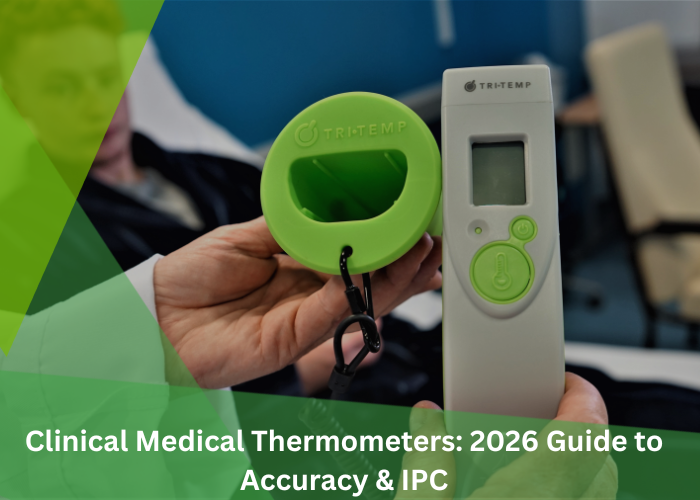
The Definitive Guide to Clinical Thermometry (2026): Accuracy, Sustainability, and IPC
Executive Summary
Body temperature is a foundational vital sign. In 2026, the transition from contact-based measurement to high-accuracy non-contact technology is driven by three pillars: clinical precision, Infection Prevention and Control (IPC), and the urgent NHS Net Zero mandate. This guide analyzes why TRITEMP™ is the benchmark for modern hospital workflows.
What Is a Medical Thermometer?
A medical thermometer is a regulated healthcare device designed to measure human body temperature for diagnostic and monitoring purposes.
Used across:
- Hospitals
- Emergency departments
- Pediatric & neonatal units
- Primary care clinics
- Home healthcare
- Public health screening programs
Unlike retail thermometers, clinical thermometers must meet regulatory accuracy, durability, and infection-control standards.
Why Accuracy is a Life-Saving Metric
In clinical settings, “close enough” isn’t enough. Temperature is a core component of the National Early Warning Score (NEWS2), which standardises the assessment of acute illness.
- Sepsis Detection: According to the UK Sepsis Trust, a temperature of $<36^{\circ}\text{C}$ or $>38.3^{\circ}\text{C}$ is a primary trigger for the Sepsis Six protocol.
- The New Physiological Baseline: Recent data published in the Journal of General Internal Medicine suggests the “standard” $37^{\circ}\text{C}$ is outdated, with modern averages closer to $36.6^{\circ}\text{C}$. Precision devices must detect these narrower variances.
- Antimicrobial Stewardship: Inaccurate readings lead to “False Fevers,” contributing to the over-prescription of antibiotics—a key concern highlighted by the WHO on Antimicrobial Resistance.
A Comprehensive Breakdown of Thermometer Technologies
Selecting the right tool requires understanding the trade-offs between accuracy, speed, and cost.
Digital Contact Thermometers (Axillary, Oral, Rectal)
Best For: Home care and low-frequency monitoring.
Clinical Reality: While the sensors are accurate, the “human element” of placement (e.g., ensuring the probe is deep in the sublingual pocket) often leads to high variability.
The Sustainability Problem: These require Low-Density Polyethylene (LDPE) plastic covers. In a 500-bed hospital, this creates tonnes of non-recyclable clinical waste annually.
Tympanic (Ear) Thermometers
Best For: Adult acute care.
Mechanism: These measure infrared radiation from the tympanic membrane, which shares the blood supply of the hypothalamus (the body’s thermostat).
The Skeptic’s View: Accuracy is often compromised by earwax (cerumen) or poor positioning. Furthermore, the recurring cost of lens filters often makes them the most expensive device to operate over a 5-year cycle.
Clinical Non-Contact Infrared (NCIT) – The TRITEMP™ Standard
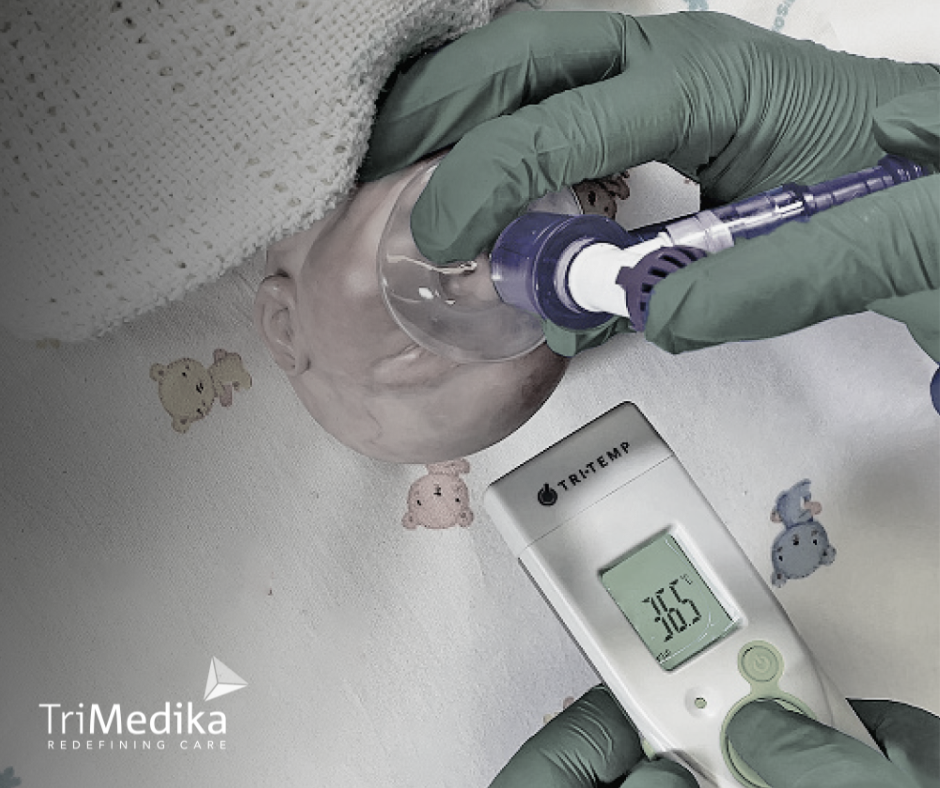
Best For: Hospitals, Neonatal (NICU), Emergency Departments, and infectious disease wards.
Mechanism: TRITEMP™ utilizes advanced infrared sensors to measure the heat signature of the Temporal Artery.
Clinical Advantage: It meets the ISO 80601-2-56 standard, ensuring that non-contact does not mean “non-accurate.” It provides a core-equivalent reading without the need for mucosal contact.
Technology Comparison: Clinical vs. Consumer Grade
Not all infrared devices are created equal. To be used in a hospital, a thermometer must meet the ISO 80601-2-56:2017 standard for clinical performance.
| Technology | Clinical Utility | IPC Risk | Environmental Impact |
| Digital Probes | High | High (Mucosal contact) | High (Single-use plastic) |
| Tympanic (Ear) | Moderate | Medium (Ear canal contact) | Medium (Consumable filters) |
| TRITEMP™ (NCIT) | Superior | Lowest (Zero-contact) | Zero Waste (No consumables) |
The Shift to “Green” Procurement
The healthcare sector is responsible for roughly 4-5% of global carbon emissions. NHS England’s Sustainable Procurement guidelines now favor “Circular Economy” products.
- Eliminating Plastic: Standard thermometers use billions of low-density polyethylene (LDPE) probe covers annually.
- Waste Reduction: TRITEMP™ eliminates the plastic waste stream entirely, directly supporting UN Sustainable Development Goal 12: Responsible Consumption and Production.
- Cost of Ownership: While the unit cost may be higher than retail alternatives, the Total Cost of Ownership (TCO) is significantly lower as it removes the recurring cost of consumables.
Infection Control: Breaking the Chain
The CDC (Centers for Disease Control and Prevention) identifies “contact with medical equipment” as a primary route for Healthcare-Associated Infections (HAIs).
- Non-Contact Advantage: By utilizing infrared sensors focused on the temporal artery, TRITEMP™ removes the device from the Chain of Infection.
- Cross-Contamination: Traditional probes require aggressive chemical disinfection between patients. TRITEMP™ requires minimal cleaning, reducing the risk of chemical degradation to the device.
- Neonatal Safety: In Neonatal Intensive Care Units (NICU), minimizing touch is vital for neurodevelopment and skin integrity.
Why TRITEMP™ is the Global Leader
TRITEMP™ isn’t just a thermometer; it is an engineered solution for the 24/7 hospital environment.
- Clinical-Grade Precision: Engineered to provide a core-adjusted reading in seconds, optimized for the forehead where blood flow is most consistent.
- Durability: Unlike “Point-and-Shoot” retail thermometers, TRITEMP™ is drop-tested and built for high-frequency clinical use.
- Workflow Efficiency: Eliminating the “search for probe covers” saves nursing time, a critical factor given the current Global Health Workforce Shortage.
Conclusion: The New Gold Standard
The evidence is clear: for a safer, greener, and more efficient ward, the future is non-contact. Moving to TRITEMP™ allows healthcare providers to meet NICE (National Institute for Health and Care Excellence) standards while simultaneously reducing their environmental footprint.
