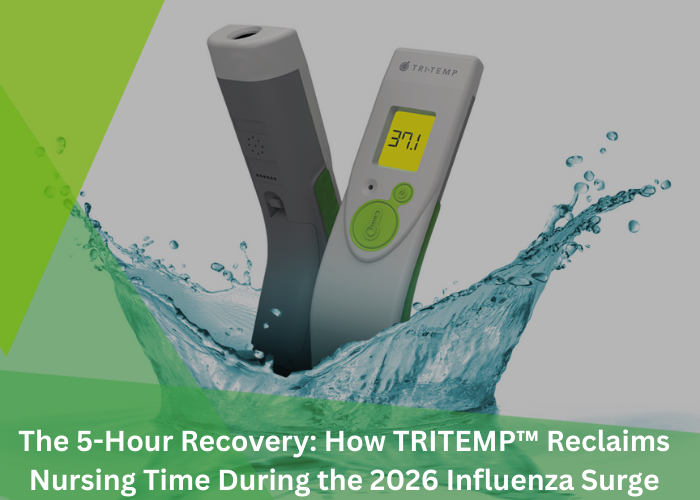
The 5-Hour Recovery: How TRITEMP™ Reclaims Nursing Time During the 2026 Influenza Surge
The Operational Crisis of 2026
As of January 2026, the global healthcare landscape has reached a definitive tipping point. The emergence of the A(H3N2) subclade K influenza variant has not only strained clinical capacity but has exposed the structural fragility of ward workflows. In the UK and Ireland, nursing vacancies remain at record highs, leaving frontline staff with a dwindling “Time to Care.”
At TriMedika, our mission in Belfast has always been to protect patients and staff through innovation. However, in the current climate, our focus has expanded. We are no longer just solving for infection control; we are solving for operational recovery.
The TRITEMP™ non-contact thermometer is at the heart of this shift. While a thermometer may seem like a basic clinical tool, the move from traditional contact-based thermometry to TRITEMP™ represents a reclamation of over 5 hours of nursing time per ward, per day.
The Anatomy of a “Time Leak” in Clinical Workflows
To understand how a hospital can reclaim 5 hours, we must first audit the “Time Leak” inherent in traditional contact thermometry (Tympanic or Oral).
In a standard 30-bed ward, temperature checks are performed as part of the National Early Warning Score (NEWS2) protocol. During a flu surge, these checks occur at least 4 to 6 times per day.
The Contact Workflow (Traditional):
- Search & Retrieve: Locating a working device and a box of specific, non-universal probe covers.
- Application: Physically attaching the plastic cover while maintaining a sterile field.
- The Wait: Allowing the device to stabilize (often 15–30 seconds of active holding).
- Disposal: Discarding the single-use plastic, which contributes to high-volume clinical waste.
- The Disinfection Cycle: Crucially, post-COVID and 2026 H3N2 protocols require a 90-second chemical wipe-down for any device that makes physical contact with a patient.
Total Time per Patient: ~3 Minutes.
The TRITEMP™ Workflow:
- The “Tap & Take”: Point the device at the forehead and click.
- Instant Result: 1-second reading.
- Zero Contact: Because the device never touches the patient, there is no need for probe covers and no requirement for the 90-second disinfection cycle between routine checks.
Total Time per Patient: ~2 Seconds.

The Math of Efficiency: Reclaiming 5.1 Hours
When we scale these “seconds saved” across a full hospital shift, the numbers are staggering.
The Calculation:
- Ward Size: 30 Beds.
- Frequency: 6 sets of vitals per 24 hours.
- Total Readings: 180 readings per day.
- Time Saved per Reading: 102 seconds (combining preparation and disinfection).
- Total Daily Savings: 18,360 seconds = 5.1 Hours.
In 2026, where ward sisters are struggling to manage staff breaks and critical care handovers, these 5 hours represent the difference between a ward in crisis and a ward in control.
Clinical Grade Accuracy: Addressing the Infrared Myth
A significant barrier to the adoption of non-contact technology has been the “accuracy skepticism” caused by the influx of low-quality, consumer-grade infrared thermometers during previous pandemics.
As a Belfast-led MedTech leader, TriMedika has engineered TRITEMP™ to transcend these limitations. Unlike “no-touch” gadgets found in retail, TRITEMP™ is a Class IIa Medical Device optimised for the rigors of the ICU and Neonatal units.
The Science of the Thermopile Array
TRITEMP™ utilises a proprietary thermopile sensor array. Most infrared devices struggle with Ambient Temperature Drift, if the ward is hot, the reading is high. TRITEMP™ features Automatic Ambient Temperature Compensation. It samples the room’s temperature 10 times per second and offsets the reading to ensure a clinical accuracy of + 0.2°C (+0.4°F).
This level of precision, validated against ISO 80601-2-56 standards, provides clinicians with the confidence to make life-saving decisions without the cross-contamination risks inherent in tympanic devices.
Sustainability and the NHS Net Zero Mandate
By 2026, the NHS and HSE (Ireland) have moved beyond “encouraging” sustainability; it is now a procurement mandate. Any hospital still using probe covers is actively failing its carbon reduction targets.
The Plastic Problem
A typical 900-bed hospital consumes approximately 2.1 to 3 million plastic probe covers annually. These are not recyclable; they are contaminated clinical waste that must be incinerated, contributing significantly to the hospital’s Scope 3 emissions.
The TRITEMP™ Solution
By switching to TRITEMP™, a hospital removes this plastic waste stream entirely.
- Zero Plastic Consumables: Direct alignment with NHS Net Zero goals.
- Cost Neutrality: The “Time Savings” plus the “Consumable Savings” means the device typically pays for itself within 4–6 months.
- Local Manufacturing: Based in Belfast, TriMedika offers a significantly lower shipping carbon footprint than devices manufactured in the Far East.
Human-Centric Design: Reducing Patient Distress
In 2026, patient experience is a key metric for hospital funding. For pediatric wards and elderly care, the “contact” nature of traditional thermometry is disruptive.
- The Silent Round: TRITEMP™ allows nurses to take a sleeping patient’s temperature without waking them. This preserves the “Sleep for Recovery” protocol, which is vital in managing the delirium often seen in severe H3N2 cases.
- Non-Invasive Triage: In overcrowded Emergency Departments (A&E), TRITEMP™ allows for rapid, non-invasive triage at the door, identifying febrile patients before they enter the general waiting area.
The Belfast Innovation Leading the Way
The 2026 influenza surge has proven that we cannot solve modern healthcare problems with 20th-century tools. The TRITEMP™ isn’t just a thermometer; it is a workforce multiplier. It protects the nurse’s time, the hospital’s budget, and the planet’s future.
As we look toward the remainder of 2026, TriMedika remains committed to ensuring that every ward has the technology it needs to provide high-quality care without compromise.
People Also Ask
How much money can a hospital save by switching to TRITEMP™?
On average, a 900-bed hospital spends between £40,000 and £60,000 annually on plastic probe covers. By switching to TRITEMP™, these costs are eliminated. When combined with the reclaimed 5 hours of nursing time per ward, the total operational ROI is estimated at £120,000+ per year.
Is non-contact thermometry recommended for the 2026 H3N2 flu?
Yes. Because the H3N2 subclade K variant is highly transmissible via surfaces (fomites), non-contact thermometry is a primary recommendation for Infection Prevention and Control (IPC). TRITEMP™ eliminates the device as a vector for cross-contamination.
