Beyond the Bedside: The Role of Connected Devices in the Rise of Virtual Wards
Healthcare is leaving the building. The hospital of the future isn’t a physical place, it’s a service delivered in the patient’s own home.
This shift, driven by the global explosion of Virtual Ward technology and “Hospital at Home” programs, is one of the most significant trends in modern medicine. From the NHS in the UK aiming to deliver over 10,000 virtual beds, to the rapid expansion of acute home care in the US, the goal is clear: increase capacity, reduce costs, and improve patient recovery.
However, moving acute care to the living room brings a massive challenge. How do clinical teams replicate hospital-grade safety from miles away? The answer lies in the accuracy and reliability of the medical devices we choose.
The Backbone of Virtual Care: Remote Patient Monitoring (RPM)
Virtual Wards rely entirely on data. Remote Patient Monitoring (RPM) tools act as the eyes and ears of the clinical team.
For acute pathways, this data must be robust enough to calculate a NEWS2 score (National Early Warning Score). This is the global standard used to identify if a patient is deteriorating. If the data fed into this score is inaccurate, patient safety is compromised.
Temperature is one of the six vital signs required for NEWS2. In a hospital, temperature is taken by a professional. In a Virtual Ward, it is often taken by the patient or a visiting carer. This variable creates a risk gap that only the right technology can close.
Why “Consumer Grade” Won’t Cut It
A major hurdle for Virtual Ward technology is the “data quality” problem.
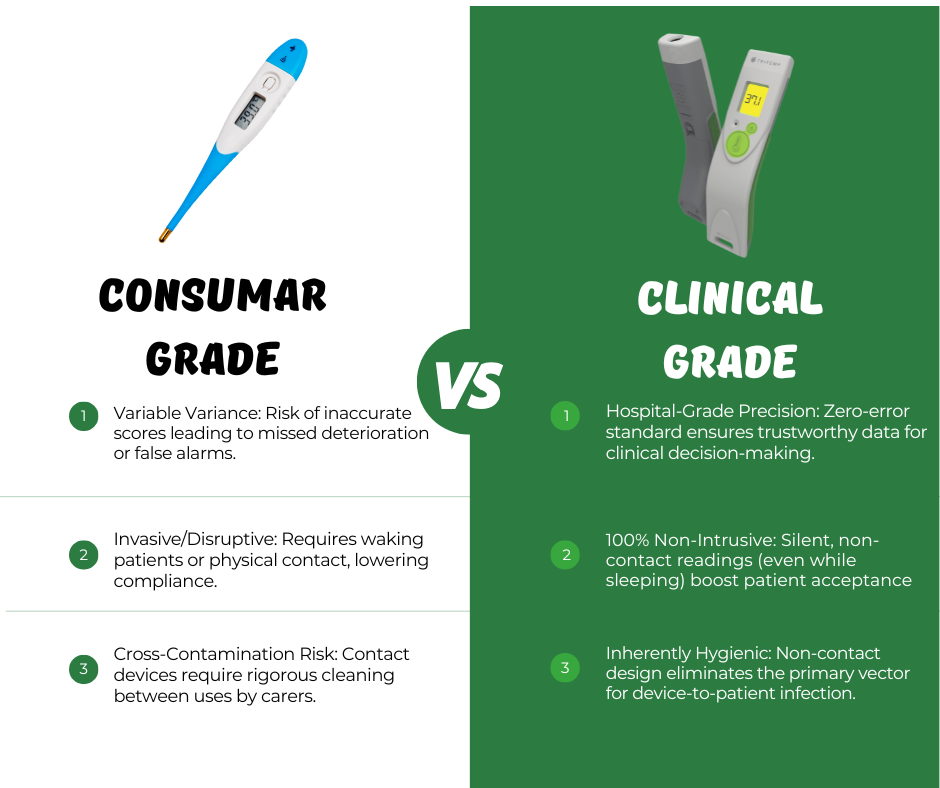
Using generic, drug-store thermometers in a high-acuity virtual setting introduces risk. Devices used for RPM must maintain clinical-grade accuracy. If a device reads low because of poor technique or cheap calibration, a sepsis spike could be missed. If it reads high falsely, it triggers unnecessary readmissions.
For a Virtual Ward to be safe, the thermometer at home must be as accurate as the one in the ICU.
Designing the Ideal Device for Home Health
To make Hospital at Home viable, medical devices need to meet three specific criteria. At TriMedika, we view these as the “3 Cs” of modern MedTech design:
1. Clinical Accuracy (Zero Error)
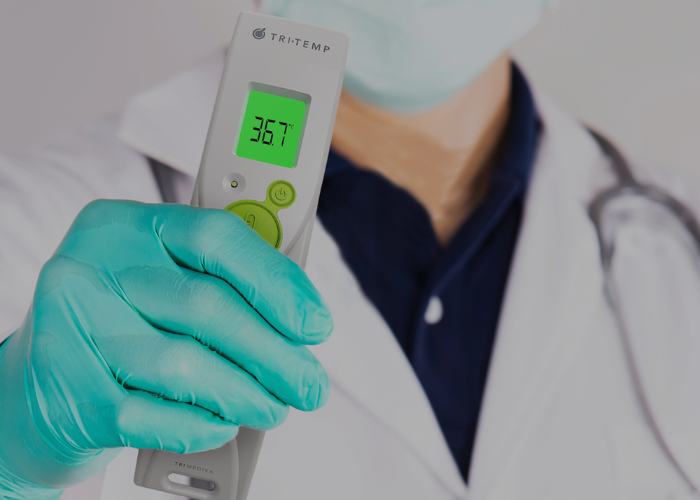
Data integrity is non-negotiable. Devices must use clinical-grade sensors that do not drift or fail in fluctuating home temperatures. This is why the TRITEMP™ is engineered for zero-consumable, high-precision readings, ensuring that a reading taken in a bedroom is as trustworthy as one taken in a ward.
2. Comfort & Compliance (The Non-Contact Advantage)
Adherence is the biggest struggle in remote monitoring. Patients recovering at home need rest.
- Zero Disruption: Non-contact technology allows carers to check vitals without waking a sleeping patient.
- Zero Anxiety: Invasive devices lower compliance. A simple “point and click” approach ensures patients actually take their measurements on time.
- Sustainability: Eliminating plastic probe covers isn’t just about being green; it removes the logistical nightmare of shipping consumables to thousands of patient homes.
3. Connectivity (The Future of Integration)
The future of Virtual Ward technology is seamless data flow.
Currently, many virtual wards suffer from “siloed data”, measurements that don’t talk to the Electronic Patient Record (EPR). The next evolution of medical devices must be interoperable. This means devices that don’t just take a reading, but securely transmit that data directly to clinical dashboards using standards like HL7 FHIR.
The Future is Integrated
The transition to Virtual Wards is not just a trend; it is a permanent restructuring of global healthcare.
To make this transition safe, procurement leads and clinical directors must look beyond the software platforms and focus on the hardware at the “edge” of the network.
A thermometer is no longer just a thermometer. It is a critical data node in a complex digital network. By prioritising clinical accuracy, non-contact comfort, and future-ready connectivity, we can ensure that “Hospital at Home” is just as safe as the hospital itself.
